
Git push
The webhook is checked with an HMAC signature before it queues anything.
Git is the source of truth. The Narrative service is a build-and-deploy machine attached to it, so no laptop has to be in the loop.

Content, templates, and settings live in each site's repository. The service holds a registry and build history, and nothing it stores is the only copy of anything.
A commit lands on the staging branch. It can come from an editor, the command line, an MCP call, or the web app, and every one of them is a git commit with the acting person as author.
A verified webhook queues a build. Builds of the same site and stage run one at a time, because they share an output folder and a cache. Different sites render in parallel.
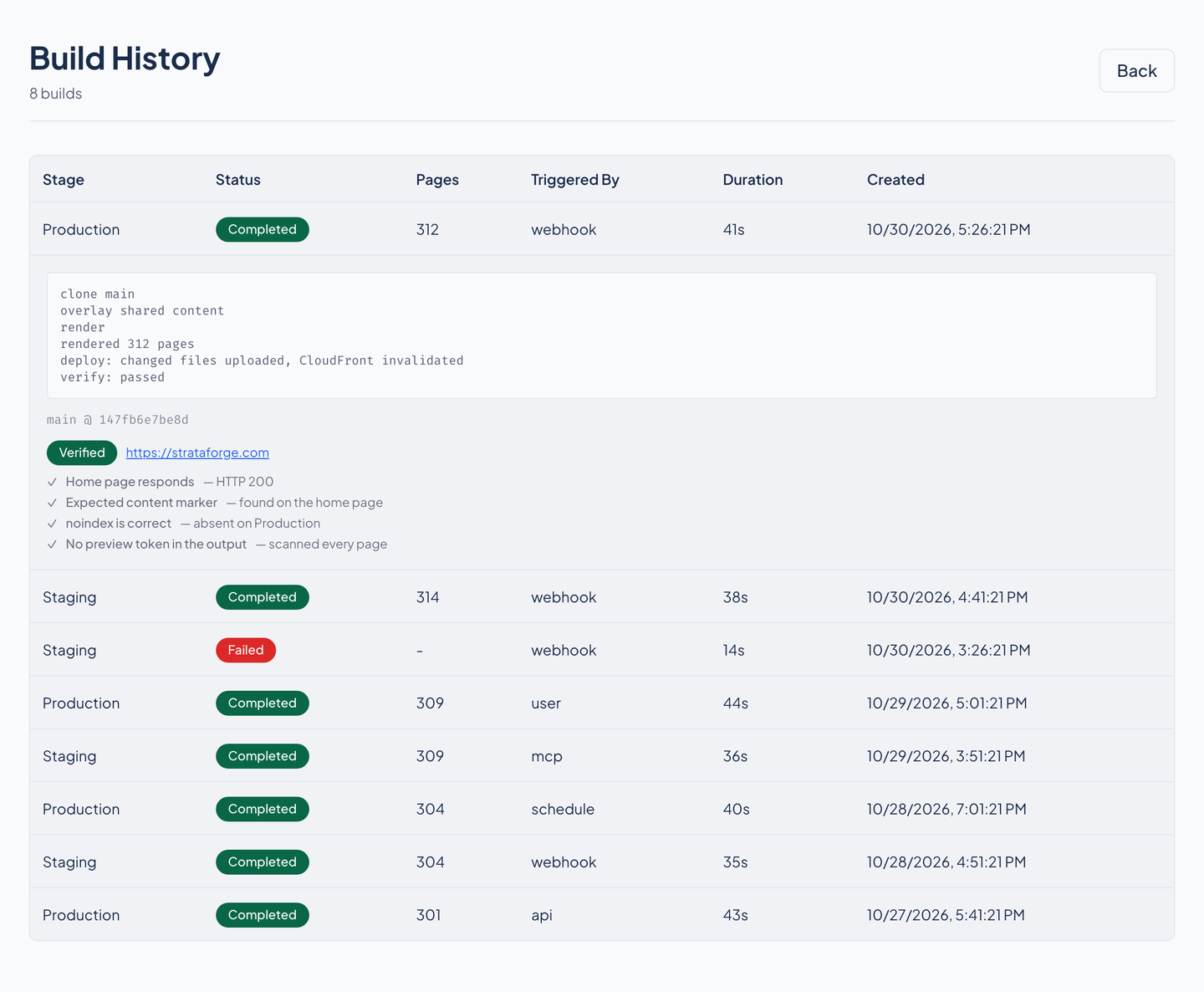
After the deploy, Narrative checks the live site. A failed check fails the build, and the report stays in the build history.
Promote merges staging into production and deploys it. Rollback is a revert, so history stays append-only.
A git push, a command, an MCP call, and a button in the web app all invoke the same server-side pipeline. Only the recorded trigger differs.
The webhook is checked with an HMAC signature before it queues anything.
narrative deploy, promote, rollback, status, and doctor. It installs with pipx.
Twenty-six tools cover sites, members, content, builds, deploys, promotes, and rollbacks.
Sites, content, and build history in one place, with each edit committed to git.
These checks used to be a manual routine. Narrative runs them for every deploy and keeps the result with the build.
| The page responds | The home page of the live site answers with a good status. |
|---|---|
| Expected content | A marker that should be in the page is there, so a blank or wrong deploy is caught. |
| Staging is noindex | A staging site is marked so search engines stay away, and production is not. |
| No preview token leaks | A scan of the production output finds no preview access key. |
A gated staging site still verifies. The checker signs in through the VelvetRope gate the same way a visitor would.
Promoting is a merge of staging into the production branch, with the full history kept. Rolling back is a revert commit, never a force-push, so a rollback can itself be undone.
A site in another AWS account deploys through a role Narrative assumes with an ExternalId for that account. A person's sign-in is never used.
Content can wait for its moment. Put a publish_at date in front matter, and a scheduler checks every site each minute and publishes what is due.
Each build records its stage, status, page count, what triggered it, the commit it built, how long it took, and its verification report. Open a build in the web app to read its log.
Write to Renkara Media Group and a person will answer.